
Pressures
Thank you to everyone who took part in our Arborfield and Barkham consultation! Please note that the survey has now closed. We are analysing your valuable comments, and will update the website when the next stage of the project begins.
Quick Summary
This page looks at how future development could be shaped to protect what matters most to the community.
Neighbourhood planning can be used to secure benefits from growth. In other areas, communities have supported housing in return for new infrastructure such as schools, transport improvements or community facilities. Here, the focus is on using future development to help protect rural identity, prevent settlements from merging, and strengthen green infrastructure around existing communities.
The page also explores whether growth could support better traffic management and more sustainable travel, including safer walking and cycling routes, improved bus services, and other changes that reduce reliance on cars. It raises questions about access to health services, especially GP provision, and whether new or different forms of health and community facilities are needed. Finally, it considers how local heritage, woodland and green spaces can be protected or better integrated into future development. Many of these ideas would require clear planning policies and strong local support to be delivered.

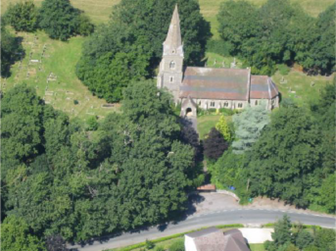
How Can We Influence Future Development To Retain Those Features That Are Important to Us?
Across the country neighbourhood planning teams have used housing demand to their advantage. There are many examples of neighbourhood plans allocating sites in return for a piece of infrastructure (a new school, a bypass, a bigger supermarket, a car park) to make their area a better place to live and work.
We have access to, or are planned to have access to, neighbouring urban and village employment, services and facilities, as well as our own, once development at Arborfield Green and Loddon Garden Village are complete.
Our local area faces the kind of pressures which are in direct conflict with accepting more development. We must therefore be more creative in securing benefits from future growth.
1. Retaining Identity and Avoiding Coalescence of Settlements
What if we utilised the provision of that space to create multi-functional green infrastructure space around our existing communities to protect their identities, their history and their value to the community as well as to avoid the coalescence of settlements?
Most developments in this area must make provision for natural green space as part of their proposals. This could be used to our advantage to develop the green infrastructure rings which would be of so much benefit to the community.
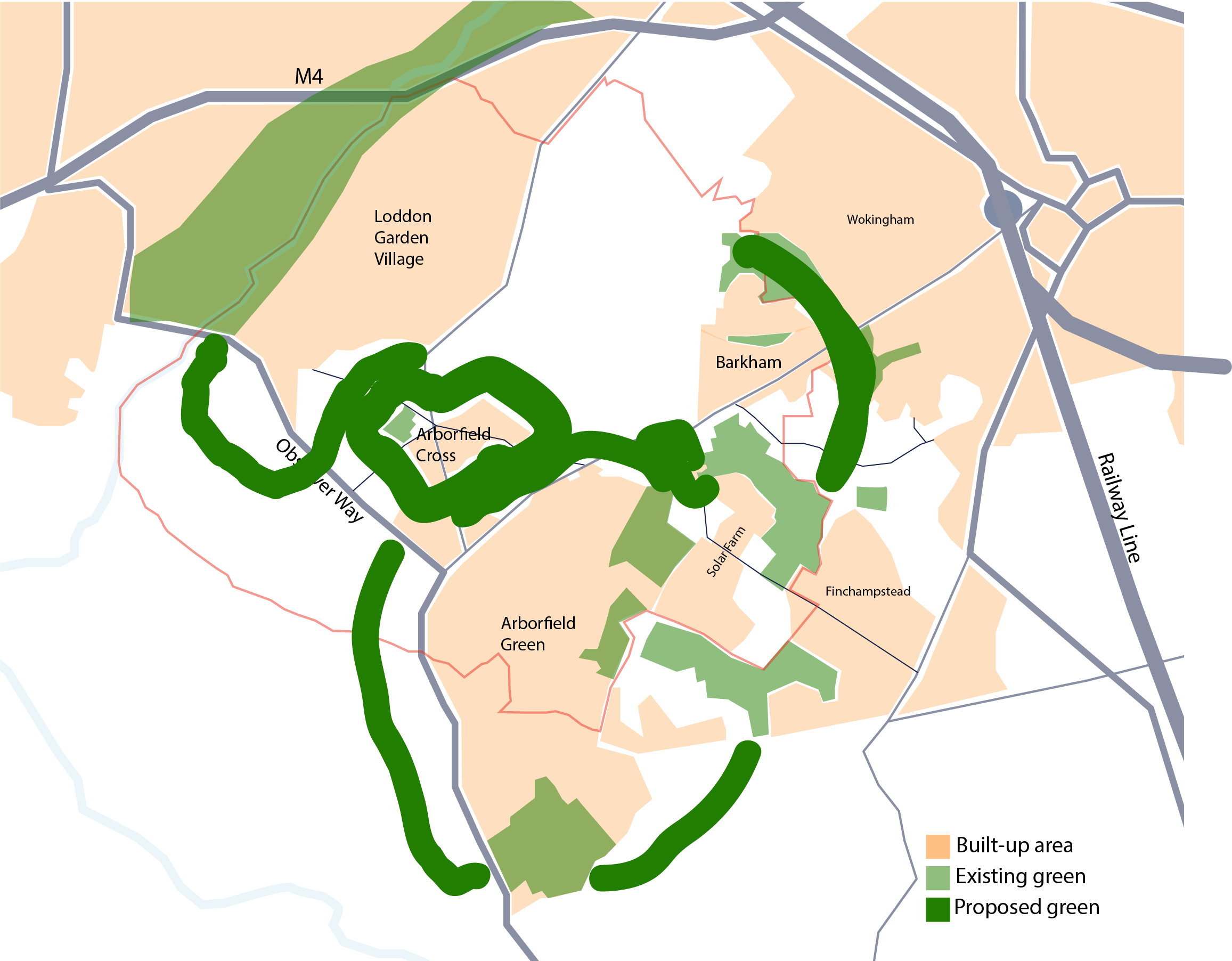
However, we would only be able to deliver this if we get this commitment written into planning policy. We can either do this through a Neighbourhood Plan, or by requesting this within the next Local Plan.
What if we also recognised the important role of our remaining countryside as a shared rural setting between our settlements whilst acknowledging that this would mean development may need to be accommodated elsewhere?
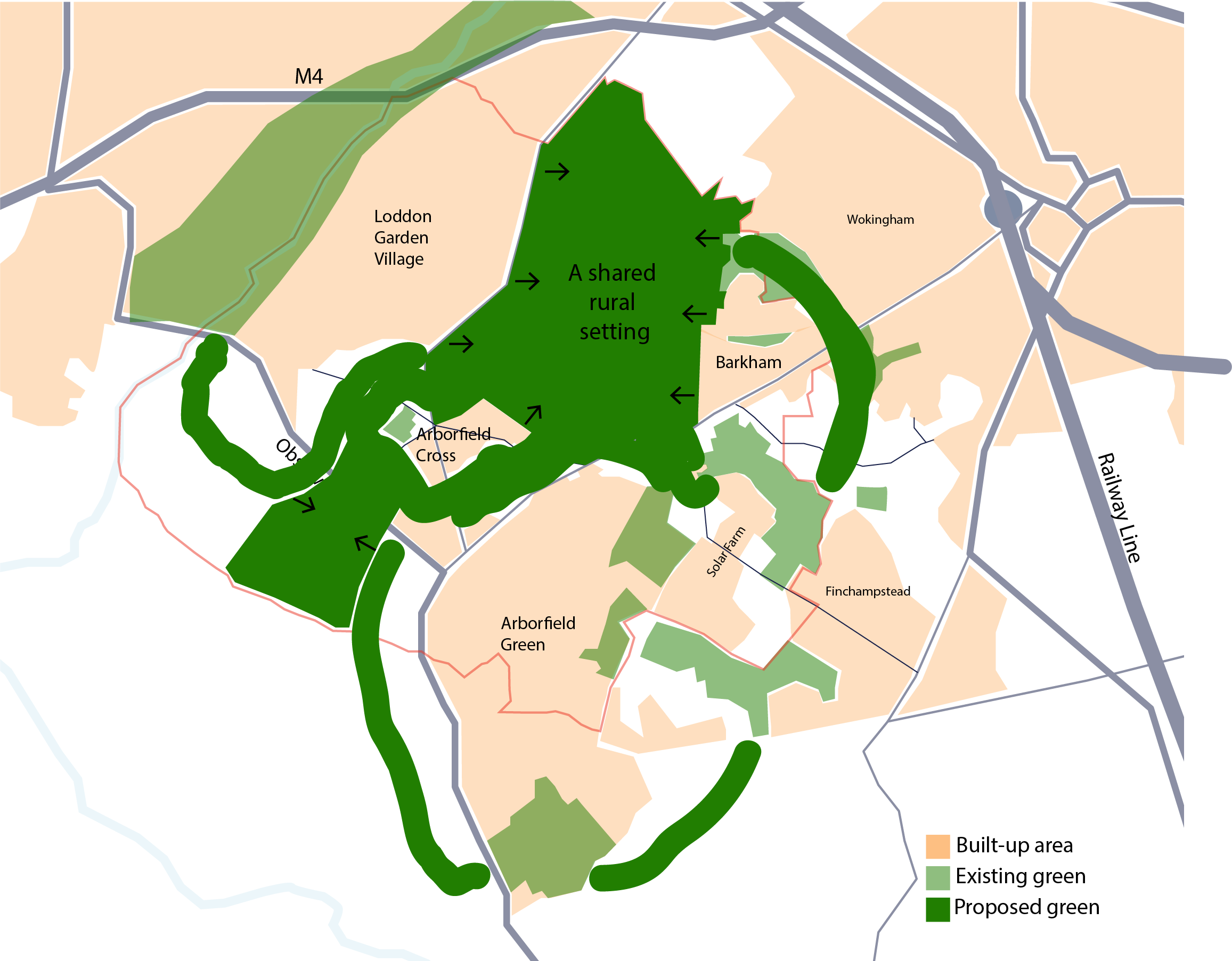
The emerging Local Plan is already proposing to recognise these spaces as valued landscape areas although a new national policy seeks to remove this specific designation from policy. We can build on this commitment to recognise the role of this space in more than just landscape terms through a Neighbourhood Plan.
2. Managing Traffic and Transport Measures Properly
To provide an alternative to cars as the key mode of transport: what if positive changes were made so that it was easy, convenient and fast for people to choose to take more sustainable options such as the train, bus, walk or cycle to their destination? What if the most direct routes were for walking, cycling, horse-riding and public transport; and vehicles were directed through other routes, keeping car, cyclist and pedestrian spaces separate?
- This could be achieved via a combination of keeping through traffic on the strategic network and using modal filters (bus gates, for example) for local streets
- Creating new Greenways for pedestrians, cyclists and horseriders (already a WBC concept)
- Other interventions like cycling infrastructure at key destinations, community e-bike schemes, delivery lockers/cargo-bike delivery base etc.
- Creating an environmentally friendly rapid transport to major travel and work hubs
Will such radical intervention alongside more development make these measures viable and help to achieve effective traffic and transport management?
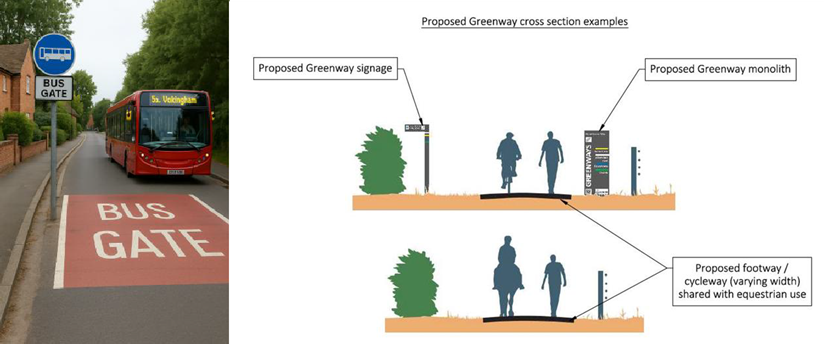
AI Generated Image and Wokingham Borough Council Greenways Concept Image
We don’t yet know whether it will be possible to obtain a strategic commitment or to secure enough funding from development for these kinds of interventions although some of them are already supported in principle. We first need to know whether there is local support for pursuing this direction which will be gathered through the consultation period.
3. Access to Health and Other Community Infrastructure
Health Infrastructure
When we think about health infrastructure, we need to think about how we make sure everyone will have appropriate access to a GP and other health services. Will this be through residents travelling elsewhere or through a provision for a health outreach space being made available?
We know that new health infrastructure is unlikely to be provided through the existing allocations in the Local Plan (from the experience of the most recent local development sites). The stakeholders involved are not planning on opening new surgeries as part of their future growth models. While there are other ways to access your GP, including virtual consultations, we know that these will not work for everyone and every health issue. This is an issue that needs to be addressed alongside continued further development as neighbouring surgeries are oversubscribed and access to see a GP has become difficult.
Community Infrastructure
Is there any other type of community infrastructure that is missing or will be needed in the future?
Both local plans and neighbourhood plans can make allocations requiring the delivery of community infrastructure. Plans can deliver the space in an appropriate location but delivery of the service or facility will require the providers and local stakeholders to work together to make these plans a reality. The community would therefore benefit from considering what amenities are needed to improve life in the local area and include their opinions in their survey response to the stakeholder consultation.
4. Retaining and Protecting Local Heritage, Woodland and Green Spaces
Are there any missing green spaces that has not yet been considered for designation?
National and local policies are already in place to protect designated local green spaces and ancient woodland from harmful development. We anticipate that these policies will be retained in the years ahead.
Sources: Esri and © Crown copyright and database rights 2026 OS AC0000815585
Are there any opportunities to integrate our local heritage into future development?
Under planning law, heritage assets are approached slightly differently. The focus is less on outright preservation and more on sustainable management and integration into future development. National and local policies encourage balancing public benefit and preservation, adaptive reuse and the management of harm, therefore, allowing development and heritage to co-exist.